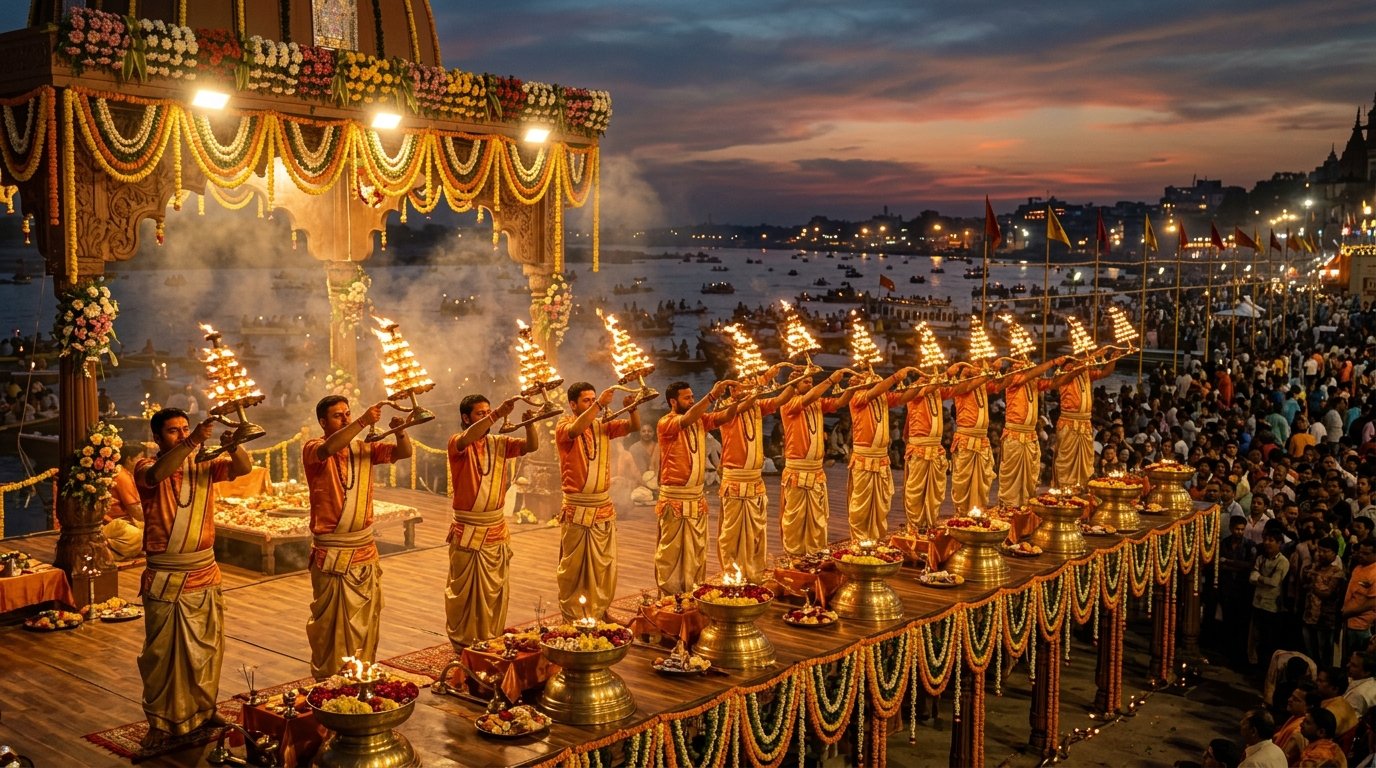
When thousands of devotees gather under the open evening sky, the sudden, unified blare of 16 sacred conch shells (Shankhs) piercing the dusk air commands instant, breathless silence. Across a monumental elevated dais, 16 initiated Vedic scholars from Kashi lift blazing brass multi-tiered lamps in flawless, rhythmic synchronization. This is not merely an event; it is the living spiritual transcendence of Varanasi’s Dashashwamedh Ghat brought directly to your festival grounds.
Cultural festivals, mega Durga Puja pandals, centenary temple celebrations, Ganesh Utsavs, and landmark heritage conventions thrive on one core element: transformative collective experience. While standard entertainment options fade into memory, the spiritual resonance of an authentic 16-Priest Ganga Aarti leaves an indelible imprint upon every devotee and guest.
Arranging a ceremony of this magnitude is a masterwork of sacred choreography, acoustic staging, crowd dynamics, and uncompromised Vedic integrity. In this definitive guide, the master Acharyas and event production directors at Varanasi Ganga Aarti reveal the step-by-step blueprint for scaling the grandest 16-priest Vedic ritual for cultural celebrations across India and worldwide.
The Sacred Numerology of 16: The Spiritual Significance of Shodasha
In Vedic philosophy and ritual tradition, numbers are not arbitrary quantities; they are sacred cosmic frequencies. While private ceremonies often feature 3, 5, or 7 priests, the 16-Priest Maha Ganga Aarti holds the highest ceremonial hierarchy for public festivals.
Shodasha Upachara
Each of the 16 priests embodies one of the 16 sacred divine offerings (Shodasha Upachara) prescribed in the Agamas—from Avahana (invocation) to Deepam (cosmic light) and Pradakshina (reverent surrender).
16 Kalas (Cosmic Wholeness)
Sixteen represents the complete cycle of the moon (Shodasha Kala) and cosmic totality. When 16 priests chant Vedic mantras in unison, the vibrational field envelops up to 50,000 devotees in deep meditative harmony.
For festival committees and organizers, choosing 16 priests communicates uncompromised prestige, cultural patronage, and absolute spiritual dedication. It turns an ordinary festival evening into a landmark spiritual spectacle that becomes the viral focal point of local and national media coverage.
Architectural & Stage Engineering Blueprint for 16 Priests
Executing an authentic Ganga Aarti with 16 priests demands precise physical planning. Unlike a musical concert where performers share close stage space, each priest performs wide, sweeping circular motions with heavy 10 to 15 kg brass lamps (Deepams), requiring individual ritual platforms (Chaukis) and safe thermal clearances.
Critical Stage Rigging & Thermal Safety Guidelines
- Chauki Platform Specifications: Each priest requires a dedicated raised wooden chauki (3.5 ft × 3.5 ft, elevated 12 to 18 inches above stage floor), draped in fire-retardant saffron silk and bordered with fresh marigolds and brass urlis.
- Priest Spacing: A strict 3.5 to 4.0 feet center-to-center clearance between priests is mandatory to allow unrestricted 360-degree rotational movement during the Parikrama phase.
- Load Bearing & Heat Shielding: Total weight across 16 priests, assistant servers, and solid brassware exceeds 2,200 kg. Platforms must be industrial-grade wooden decks with non-slip carpets and fire-resistant brass base plates beneath heavy oil burners.
- Overhead Clearance: Maintain at least 16 to 18 feet of unobstructed vertical clearance above flame tips, free from hanging fabric, low trussing, or decorative plastic leaves.
Acoustic Architecture: Mastering 16 Shankhs, Damrus, & Chanting in Unison
The audio dimension of a 16-Priest Ganga Aarti is an overwhelming sensory journey. If not engineered properly, 16 powerful voices, ringing brass ghantas, and conch shells can turn into acoustic distortion. When calibrated correctly, it generates a transcendent sound bath that captivates audiences.
Sound Engineering Requirements for 16 Priests:
- Lead Acharya Microphones: 2 high-grade wireless directional lavalier or discreet headworn condenser microphones for the chief Vedic scholars leading the Sanskrit stutis and sankalp.
- Stage Boundary (PZM) Mics: 4 to 6 wide-dispersion boundary floor microphones placed strategically along the dais to capture the natural acoustic chime of brass ghantas, water oblations, and chorus responses.
- Damru & Shankh High-SPL Microphones: Dynamic high-sound-pressure cardioid microphones on boom stands dedicated to picking up the thunderous beats of our Specialized Damru Vadan Troupe without peaking or clipping.
- Subwoofer Distribution: Subtle low-end reinforcement (50 Hz – 120 Hz) to allow the deep bass frequencies of 16 synchronized conches to reverberate physically through the audience.
The 7-Phase Ritual Choreography: Step-by-Step Festival Run Sheet
Every movement in the Ganga Aarti follows a rigorous sacred chronology established over centuries in Kashi. For a 16-priest festival performance, this 45-to-60-minute ceremony is choreographed with millisecond precision:
Phase 1: Shankhanaad & Swasti Vachan (00:00 – 00:08)
16 priests step onto their chaukis in complete silence. In unison, they lift pure ocean conches and blow three extended, harmonized blasts of Shankhanaad. The Lead Acharya begins the ancient Rigvedic Swasti Vachan, purifying all ten directions.
Phase 2: Maha Sankalp & Ganga Pujan (00:08 – 00:15)
Chief festival patrons, trustees, and VIP dignitaries are invited to the central altar for the sacred Sankalp. Sacred water from Varanasi's Manikarnika Kund and Gangotri is offered alongside pure chandan, akshat, and bilva leaves.
Phase 3: Dhoop Aarti (Incense Purification) (00:15 – 00:22)
16 elaborate brass Dhoop Dani censers are ignited with pure guggul, loban, and sambrani. In synchronized 8-directional motion, fragrant, sanctifying smoke billows across the audience, driving away negative energies and creating a divine aura.
Phase 4: Shodasha Deepam Aarti (The Grand Pyramids of Fire) (00:22 – 00:35)
The climax of visual majesty. 16 multi-tiered brass pyramid lamps—each holding 51 pure Desi cow ghee wicks—are ignited simultaneously. All 16 priests rotate and elevate the heavy lamps in synchronized cadence to the chanting of Om Jai Gange Mata and Vedic Stutis.
Phase 5: Kapoor Aarti & Chamara Seva (00:35 – 00:43)
Pure organic Bhimseni camphor is lit in serpent-shaped brass Naga Deepams. As pure white flames dance, priests transition to the soothing waving of the Chamara (sacred yak-tail whisk) and majestic Mayur Pankh (peacock fans).
Phase 6: Damru Vadan, Pushpanjali & Har Har Mahadev (00:43 – 00:55)
The high-energy crescendo. 16 damrus erupt in ecstatic rhythm alongside grand brass gongs. Tens of thousands of devotees join in shouting "Kashi Vishwanath Bhagwan Ki Jai" and "Har Har Gange" as a shower of quintals of fresh rose and marigold petals rains upon the gathering.
Comparative Tier Analysis: Choosing the Right Aarti Scale
While the 16-priest setup is the crowning jewel of mega festivals, evaluating your venue size and budget will help you select the ideal format:
Devotee Engagement & Crowd Choreography for 10,000+ Gatherings
When organizing a 16-priest ceremony for tens of thousands of visitors, passive viewing is not enough. The key to viral success and spiritual fulfillment is active devotee participation:
- Synchronized Deepdaan (The Sea of Golden Light): Distribute 5,000 to 10,000 pre-wicked clay or eco-friendly leaf diyas to the audience. When the 16 priests initiate the Kapoor Aarti, the entire stadium or riverfront lights up their diyas simultaneously, transforming the grounds into an ocean of flickering golden lights.
- Multi-Angle 4K LED Live Streaming: Mount dual jib cranes and high-definition robotic PTZ cameras around the stage. Feed live synchronized close-ups of the blazing brass lamps and priest mudras directly to LED screens placed every 50 meters throughout the fairgrounds.
- VIP Sankalp & Holy Prasad Channels: Establish isolated, barricaded corridors directly in front of the central chauki for state dignitaries, temple trust donors, and special guests to offer flowers and receive sanctified Chandan Tilak and Ganga Jal without obstructing public sightlines.
Complete Production Timeline: From T-30 Days to Live Aarti
Countdown Checklist for Festival Directors:
- T-30 Days: Finalize booking with Varanasi Ganga Aarti, confirm priest entourage count (16 Shastri priests + 4 ritual assistants + Acharya coordinator), lock date and venue technical specs.
- T-15 Days: Approve stage design and structural load tests. Coordinate local fire department clearance for open flame camphor and ghee usage. Dispatch consecrated heavy brassware via dedicated logistics if venue is outside North India.
- T-2 Days: Priest entourage departs Varanasi via air/express train. Arrange sattvic hospitality and private green room facilities near the festival stage.
- T-6 Hours: On-site stage dressing: Chauki positioning, marigold garland draping, brass urlis filled with fresh petals and floating candles, soundcheck and acoustic EQ balancing for conch frequencies.
- T-0 (Twilight): Commence the 16-Priest Maha Ganga Aarti. Complete broadcast synchronization and crowd containment protocol.
Frequently Asked Questions (FAQs)
1. Can a 16-Priest Ganga Aarti be arranged anywhere in India or abroad?
Yes. Our team frequently travels across India—including major metros like Mumbai, Delhi, Bengaluru, Hyderabad, Kolkata, Pune, Ahmedabad, and Chennai—as well as international cultural centers such as Dubai, London, Bangkok, and Singapore. We manage all logistics for priest transit, brassware cargo, and authentic Kashi samagri.
2. How much advance notice is required to book 16 priests?
Due to the extensive preparation, background verification of initiated Brahmins, and specialized travel coordination, we recommend reserving your date 4 to 8 weeks in advance, particularly during high-demand festival seasons like Navratri, Diwali, Karthik Purnima, and Ganesh Chaturthi.
3. Is it safe to light 16 multi-tiered brass lamps inside a covered pandal or pavilion?
Yes, provided the venue maintains adequate ceiling clearance (minimum 16-18 ft) and proper air circulation. We utilize 100% pure organic Desi cow ghee and smokeless chemical-free Bhimseni camphor, ensuring smooth, non-toxic, and steady illumination that creates minimal residue.
4. Can we customize the aarti to include specialized Stutis for our festival deity?
Absolutely. While the core Ganga Aarti remains authentic to Kashi traditions, our Acharyas seamlessly incorporate deity-specific Vedic invocations—such as the Mahishasura Mardini Stotram for Durga Puja, Ganesh Atharvashirsha for Ganesh Utsav, or Shiva Tandava Stotram for Maha Shivratri celebrations.
Bring the Sacred Radiance of Kashi to Your Cultural Festival
Elevate your upcoming celebration with the ultimate expression of Vedic magnificence. Speak directly with our head coordinators to receive a tailored quotation, technical staging rider, and date availability for our 16-Priest Ganga Aarti entourage.
Planning a Corporate Gala, Wedding, or Festival?
Reserve authentic Varanasi Vedic priests with complete traditional brass paraphernalia. Packages starting from ₹35,000+.

Varanasi Ganga Aarti Trust
Dedicated custodians of eternal Vedic rituals, bringing the sacred grandeur, authentic chantings, and divine blessings of Kashi's holy Ganga Aarti to venues across India and worldwide.