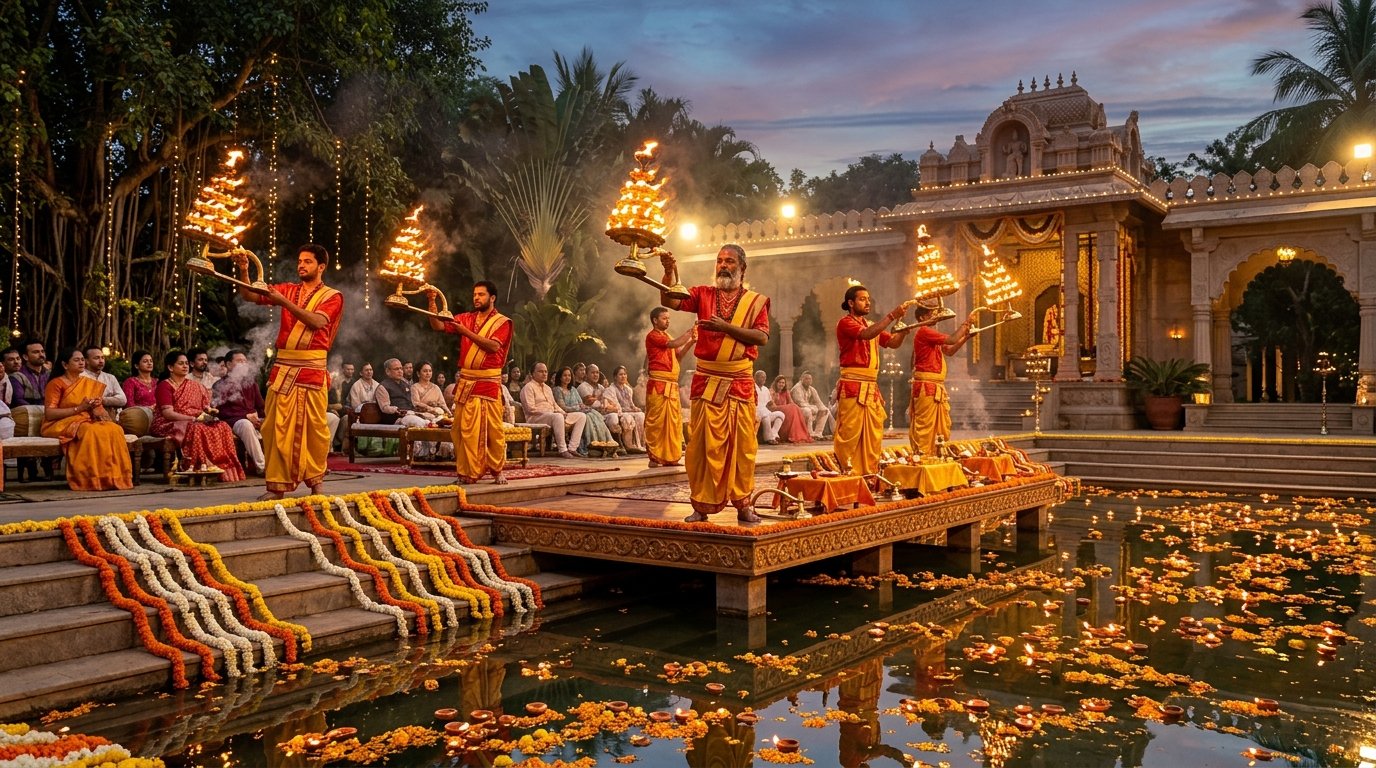
Every evening at sunset, the ancient stone steps of Dashashwamedh Ghat in Varanasi ignite into a mesmerizing symphony of sensory transcendence. The thunderous resonance of conch shells (Shankhnaad), the hypnotic rhythm of temple brass bells (Ghanta), the scent of burning Himalayan Loban and Bhimseni camphor, and the sight of multi-tiered brass deepams rotated in perfect sacred synchrony create one of the most spiritually electrifying spectacles on Earth. For couples planning a luxury wedding in Bengaluru, airlifting 300 to 500 guests to the narrow alleyways of Kashi can be an overwhelming logistical challenge. But what if you could authentically bring the sacred Ghats of Varanasi directly to Bangalore’s most stunning heritage resort venues?
Simulating the authentic Banaras Ghat experience is far more than hiring a few local pandits to wave a handheld diya. It requires a meticulous blend of sacred spatial geometry, authentic heritage brassware, floral architectural layering, warm-temperature lighting choreography, and live acoustic synchronization. When executed with precision, a resort water body in Bangalore—whether a natural stone Kalyani, an expansive lotus pond, or a tiered infinity pool deck—transforms into the sacred banks of the Ganges, leaving wedding guests spellbound and emotionally moved.
The Core Philosophy of a Ghat Simulation
An authentic Ganga Aarti setup cannot look like a generic stage performance. It is a Tirtha recreation—a sacred threshold between water, earth, fire, and sky. Every single visual and acoustic cue must deliberately echo the centuries-old Dashashwamedh Ghat traditions curated by Vedic scholars born and trained in the spiritual heart of Kashi.
Prime Bangalore Resort Venues That Naturally Embody the Ghat Aesthetic
The secret to an effortless Ghat simulation lies in selecting a venue with built-in stepped stone architecture, reflective water bodies, and mature natural foliage. Bangalore boasts several premier resort venues whose topography naturally mirrors the physical characteristics of Varanasi's riverfront:
The Tamarind Tree (Kanakapura Road)
Features an authentic stepped stone pond (Kalyani) encircled by antique granite pillars and century-old banyan canopies. The descending stone tiers effortlessly replicate the physical steps of Assi or Dashashwamedh Ghat, providing natural tiered seating for 250+ guests.
Clarks Exotica Convention Resort (Devanahalli)
Expansive water bodies paired with stepped amphitheater lawns make Clarks Exotica ideal for large royal setups featuring 5 to 7 priests. The expansive water surface produces breathtaking reflections of the multi-tiered brass flames during the twilight hour.
Jade 735 (International Airport Road)
A haven for intimate luxury weddings and pre-wedding welcome dinners. Its sunken lounge and floating wooden pavilion directly over the water deck allow for an intimate 3-priest Aarti where guests sit at water level with floating diyas at their fingertips.
Miraya Greens (Kanakapura Road)
Surrounded by manicured waterfront promenades and natural stone terraces. The long linear water edge allows priests to stand in an imposing, perfectly spaced ceremonial row while guests observe from elevated terraced decks.
Explore our full guide on hosting Ganga Aarti for weddings in Bangalore to evaluate resort permits and seasonal booking windows.
Step 1: Spatial Geometry & Water Mirroring (The "Ganga" Foundation)
The defining characteristic of Varanasi is that the Aarti is performed on the riverbank, looking out over the holy waters of the Ganga. To recreate this psychological resonance in a resort environment, you must adhere to three non-negotiable spatial rules:
- Cardinal East Orientation: In Vedic ritual architecture, priests performing Aarti face East (Purva) toward the rising energy or directly face the reflective water body. Aligning the priest pedestals on the western bank facing east over the water ensures both authentic scriptural compliance and optimal visual sightlines for guests seated on the opposing or flank tiers.
- Zero-Barrier Water Proximity: Avoid setting up the priest platforms more than 3 to 4 feet away from the water edge. The true magic occurs when the golden flames of the 108-wick lamps cast undulating liquid amber reflections across the surface of the resort pool or Kalyani.
- Floating Diya Dispersion: A calm swimming pool or stepped pond will look artificial unless brought to life with sacred movement. Release between 300 to 700 floating terracotta deepams, handmade brass mini-diyas, and loose marigold / lotus petals across the water. Use cotton wicks dipped in pure camphor oil and weighted lotus leaf cups so gentle evening breezes float the lamps naturally without overturning them.
Step 2: The Sacred Chowki & Chhatri Architecture (Exact Specifications)
At Dashashwamedh Ghat, each priest commands an individual raised wooden platform known as a Chowki or Takhat, sheltered beneath an ornate ceremonial canopy (Chhatri). A frequent mistake made by local event decorators is placing all priests on a flat, generic banquet stage. This instantly destroys the authentic temple-sanctum aura.
Here are the exact architectural dimensions and styling specifications required for a pristine simulation:
📐 Dimension & Specification Blueprint for Priest Chowkis
Individual wooden takhat elevated 18 to 24 inches above the base deck.
Ensures priests have a full 360-degree rotation buffer while waving heavy multi-tiered lamps.
Skirting finished with real gold Zari or authentic Banarasi brocade borders.
Elevated 7.5 feet overhead, draped with suspended brass temple bells and fresh marigold tassels.
The Front Puja Console Setup:
Directly in front of each priest’s platform sits a lower 2.5 ft x 1.5 ft console table draped in matching saffron velvet. This console holds the consecrated ritual implements: a brass Panchapatra with sacred Achamani spoon, unbroken raw rice (Akshata), red sandalwood paste (Raktachandan), an engraved brass tortoise-stand supporting the sacred conch shell, a pure brass Kamandal filled with sacred Kashi Ganga Jal, and traditional brass sprayers holding pure floral ittar (attar).
Step 3: The Authentic Brass Aarti Arsenal (Weights, Tiers & Sourcing)
The visual soul of Ganga Aarti resides in the heavy, solid cast-brass ritual instruments. In generic event setups, suppliers frequently supply flimsy, lightweight aluminum copies with pressed gold polish that overheat, wobble, or tip during rotation. Authentic Varanasi rituals demand hand-forged, high-mass brass implements engineered to retain balance when filled with flaming camphor and ghee:
| Ritual Implement | Material & Specs | Weight & Dimensions | Ritual Significance & Movement |
|---|---|---|---|
| 108-Wick Multi-Tier Deepam | Cast Brass, 5 to 7 tiers, Peacock crest summit | 8.5 kg - 12 kg | 4.0 - 4.5 ft height | The iconic centerpiece lamp. Rotated in slow, majestic clockwise orbits symbolizing the cosmic cycle of creation. |
| Panchmukhi Deepam | Solid brass with 5 stepped wick reservoirs and Cobra hood handle | 3.2 kg - 4.5 kg | 18-inch length | Invokes the five sacred elements (Earth, Water, Fire, Air, Space). Waved in horizontal S-curve waves. |
| Kapoor Aarti Chalice | Fluted brass bowl with heat-insulated dragon-tail handle | 2.5 kg | 14-inch reach | Holds burning Bhimseni camphor. Creates a towering golden plume as priests chant the climactic stotrams. |
| Dhoop Dani (Dhunachi) | Pierced lattice brass brazier with solid turned base | 2.8 kg | 12-inch diameter | Smolders organic Himalayan Loban and Guggul, sending fragrant plumes of consecrated mist across the water. |
| Vamavarti Shankh | Natural deep-sea blown conch, mirror polished | 1.2 kg - 1.8 kg | 9 - 11 inches | Produces a pure 120-140 Hz sound wave that cleanses the atmospheric field and commands instant crowd silence. |
| Garuda Bronze Ghanta | High-tin bell metal bronze with carved Garuda finial | 1.5 kg | 8-inch bell mouth | Rung in sustained 4/4 Vedic meter in synchrony with the rotating flames. |
| Chamara & Mayur Pankh | Pure white Himalayan yak-tail whisk & full peacock fan | Silver-gilt brass handle | Symbol of royal reverence (Rajopachara Puja), waved gently to cool the deity after the fire rituals. |
Read more about our dedicated ritual equipment and priest heritage on our Ganga Aarti for Destination Weddings service page.
Step 4: Floral Styling & Olfactory (Scent) Engineering
Close your eyes on the ghats of Varanasi and the first sensory impression you encounter is the rich, enveloping fragrance of fresh marigolds, holy basil, and crushed camphor mingling with incense smoke. Recreating the Ghat aesthetic requires treating florals and aromatics not merely as passive decor, but as dynamic experiential architecture:
1. Floral Cascades That Turn Resort Steps into Ghats
Modern resort steps—whether made of polished Italian marble or dark Sadahalli granite—look distinctly contemporary. To simulate the ancient sandstone patina of Varanasi, lay dense, continuous marigold garland runners (tightly packed 4-inch diameter ropes) along the tread and riser edges of every single step. Use a 70/30 color ratio:
- 70% Saffron Orange (Genda): Provides the quintessential sacred Hindu temple tone.
- 30% Golden Mustard Yellow: Introduces luminous highlights that catch the flickering evening firelight.
- White Rajnigandha (Tuberose) & Jasmine Accents: Suspended in vertical tassels from the priest canopies, these release intoxicating floral oils as the night temperature cools.
- Giant Brass Urlis: Position 24-inch to 36-inch antique brass urlis at the corners of each step, brimming with clean water, floating pink Indian lotus blossoms, and hundreds of fresh red rose petals.
2. The Aromatics of Kashi: Loban, Sambrani & Desi Camphor
Never allow event planners to burn cheap chemical incense sticks or synthetic smoke machines. Authentic Ghat atmosphere relies on the chemistry of sacred natural resins. Our priests burn wild Himalayan Loban, aromatic Guggul resin, and pure cow-dung Sambrani cups ignited on live coconut-shell charcoal in traditional pierced brass braziers.
Prior to guest arrival, pure water mixed with Kashi Ganga Jal and concentrated Gulab Jal (rose water) is gently misted across the stone pathways, while priests dispense pure Champa and sandalwood ittar into the warm air. The moment guests step onto the resort grounds, their senses are instantly transported hundreds of miles north to the holy city.
Step 5: Lighting Design & Theatrical Cues (Banning Harsh LEDs)
Lighting is the element that either elevates your Ghat simulation into an ethereal masterpiece or reduces it to a kitschy stage set. Modern LED pars with cold white or neon purples will instantly shatter the spiritual illusion.
💡 The Golden Lighting Rules for Recreating Kashi Ghats
- Strict Color Temperature Cap (2000K – 2400K): All stage and ambient architectural lights must be tuned to ultra-warm amber or tungsten. Any beam over 2700K appears cold, clinical, and artificial against sacred flames.
- Low-Angle Floor Uplighters: Position warm LED wash lights on the floor pointing slightly upwards toward the priests. As the priests rotate the brass lamps, their saffron silk robes glow brilliantly while casting dramatic 12-foot shadows onto heritage stone pillars or banyan trees behind them.
- Eliminate Water Surface Glare: Turn OFF direct overhead pool floodlights! Bright pool lights wash out the delicate reflection of the multi-tier deepams and make floating diyas invisible. Ambient water lighting should rely 100% on the candlelight of floating terracotta deepams.
- 3-Phase Dynamic Lighting Dimming:
• Phase 1 (Prelude / Arrival): 50% warm ambient courtyard illumination.
• Phase 2 (Aarti Climax): Ambient wash dimmed to 15%. The blazing 108-wick brass lamps and camphor chalices become the sole dominant light source across the resort.
• Phase 3 (Post-Aarti Pushpanjali): Gentle 40% amber wash returns as guests step forward to float their personal diyas and receive blessings.
Step 6: The Acoustic Soundscape & Musical Timeline (Minute-by-Minute Cues)
The acoustic signature of Varanasi is profoundly sacred and visceral. A common mistake is playing a canned Spotify Aarti bhajan through resort speakers. True immersion demands live Vedic chanting in sacred Sanskrit meter, live conch shell invocations, and live double-headed Shiva drums.
Our authentic Varanasi Vedic priests perform with live accompaniment, including resonant Damru Vadan (Shiva Drums), brass cymbals (Manjira), and deep temple bells:
| Timestamp | Ceremonial Ritual | Audio & Percussion Cues | Visual & Stage Movement |
|---|---|---|---|
| T - 00:00 to 02:00 | The Triple Shankhnaad | Three long, synchronized blasts of the sacred conch shell (15-20 seconds each) in 360-degree directions. | Priests stand in absolute stillness facing the water, conches raised high. Complete silence falls over the resort. |
| T - 02:00 to 06:00 | Swasti Vachan & Vedic Invocations | Sanskrit chanting of Rigvedic Shanti Mantras and Ganesh Vandana; soft resonant background drone (tanpura/harmonium). | Consecration of the water body and resort grounds using brass Achamani spoons and holy Kashi Ganga Jal. |
| T - 06:00 to 10:00 | Dhoop & Sambrani Aarti | Rhythmic 3/4 temple bell ringing accompanied by the hypnotic opening beats of the Damru. | Brass Dhunachi braziers ignited with Loban and Guggul. Dense consecrated smoke drifts out across the water surface. |
| T - 10:00 to 18:00 | Grand 108-Wick Deepam Aarti | Chanting of the sacred Rudrashtakam ("Namami Samisham Nirvana Roopam") accelerating into thunderous Shiva Tandava rhythms. | Courtyard lights dim to 15%. Massive tiered brass lamps ignited with pure ghee rotate in synchronized planetary orbits. |
| T - 18:00 to 22:00 | The Blazing Kapoor Aarti | Climactic unison chorus of "Har Har Mahadev" and "Har Har Gange"; rapid double-time Damru and cymbal crescendos. | Pure Bhimseni camphor ignited in long-handled chalices. Towering bright white flames illuminate the entire water amphitheater. |
| T - 22:00 to 25:00 | Chamara & Mayur Pankh Seva | Soft, melodious flute and tanpura instrumental stotrams; gentle, meditative tempo deceleration. | Priests wave royal white yak-tail whisks and iridescent peacock fans in slow, graceful symmetrical arcs. |
| T - 25:00 to 30:00 | Pushpanjali & Guest Diya Floating | Vedic Ashirwad blessings recited over the couple and family; soothing celebratory Shehnai or Santoor chords. | Couple and guests are invited to the water's edge to float personal terracotta deepams and offer fresh rose petals. |
Authentic Kashi Simulation vs. Generic Wedding Aarti: What Sets Us Apart
For Bangalore couples and luxury wedding planners, understanding the technical differences between an authentic Vedic execution and a standard decorator setup is critical:
| Execution Element | Authentic Varanasi Ganga Aarti Team | Generic Event Decorator Setup |
|---|---|---|
| Priest Lineage & Training | Formally initiated Vedic Brahmins born & educated at Kashi Sanskrit universities; practiced daily at Dashashwamedh Ghat. | Local banquet pandits or theatrical stage performers with no training in synchronized ritual rotation. |
| Aarti Brass Hardware | Solid cast brass 108-wick peacock deepams (8–12 kg), certified Bhimseni camphor chalices, and genuine Garuda bronze bells. | Flimsy stamped sheet-metal or polished aluminum props that warp under heat and risk tipping over. |
| Fuel & Fire Safety | 100% Grade-A refined Vedic Cow Ghee and pharmaceutical-grade Bhimseni camphor; zero toxic smoke, zero carbon soot. | Paraffin lamp oils or chemical camphor cakes emitting choking black smoke that triggers ballroom fire alarms. |
| Sound & Acoustic Meter | Live natural conch shell resonance (Shankhnaad), live Sanskrit chanting, and authentic live Damru percussion. | Recorded MP3 tracks played from an auxiliary phone jack with generic synthesized beats. |
| Water & Floral Immersion | Custom weighted floating deepams, authentic Ganga Jal consecration, and calibrated marigold step runners. | Dry stage setups with no water interaction, plastic floral foam, or disconnected backdrop banners. |
Transparent Pricing & Priest Packages for Bangalore Resorts
Whether you are planning an intimate welcome dinner for 60 guests at Jade 735 or a grand Sangeet gala for 600 at The Tamarind Tree or Clarks Exotica, we offer standardized, all-inclusive packages covering authentic Kashi priests, consecrated brassware, pure fuels, and complete ritual coordination:
- Discover the best water-facing stepped courtyards and Kalyani tanks across our list of top luxury Bangalore resort and wedding venues.
- Evaluate staging, floral decoration, and priest honorarium costs in our complete Ganga Aarti pricing and tier breakdown.
- Ensure resort environmental compliance and pool safety by reviewing our fire safety and resort venue permissions guide.
Varanasi Ganga Aarti Packages
Basic Ganga Aarti setup with standard ritual offerings, decoration, and spiritual chanting.
Expanded setup with enhanced sound/chanting presence, elaborate decorations, and extra offering items.
Grand Ganga Aarti experience, double the typical count, significant spiritual resonance, special items & decorations.
Royal Scale Aarti, beautiful formations, massive public/private gathering setup, complete VIP coordination and grand visuals.
All packages include direct logistics management, consecrated brassware transport from Varanasi to Bengaluru, pure cow ghee, camphor, and comprehensive venue coordination. Learn more about customized inclusions for corporate galas and retreats on our Ganga Aarti for Corporate Events page.
Technical Logistics & Vendor Rider for Wedding Planners
To ensure an effortless execution without last-minute venue friction, share this technical rider with your Bangalore wedding decorator and resort banquet manager:
⚡ Electrical & AV Rider
- 3 Dedicated Shure wireless lapel/headset microphones for lead chanting priests.
- 2 Instrument dynamic microphones on boom stands for live Damru and Shankh capture.
- Dedicated stereo audio DI box linking the priest console to the main venue PA system.
- No high-velocity industrial cooling fans pointed directly across the priest chowkis.
🛡️ Fire Safety & Floor Protection
- Heavy brass drip trays placed beneath all multi-tier deepams to protect resort stone/wood decks.
- Flame-retardant heavy rubber under-mats installed beneath the wooden priest takhats.
- 2 Standby CO2 fire extinguishers and damp cotton blankets stationed discreetly backstage.
- Clear 6-foot safety buffer between priest platforms and front-row guest seating.
🚪 Backstage & Priest Hospitality
- 1 Clean, private air-conditioned changing room for priests 2 hours prior to start time.
- Clean drinking water and fresh cut fruits (Satvik hospitality standards).
- A secure staging area for assembling the 108-wick brass lamps and pre-soaking cotton wicks.
- Designated safe cold-dousing station for spent camphor chalices post-ceremony.
Frequently Asked Questions (FAQ)
Which Bangalore resort venues are best suited for replicating the Banaras Ghat experience?
The best venues are those featuring natural stone water bodies, stepped courtyards, or terraced lawns. Leading choices include The Tamarind Tree on Kanakapura Road (famed for its authentic stepped stone Kalyani and antique granite pillars), Clarks Exotica in Devanahalli (ideal for grand lakefront setups), Jade 735 near the airport (perfect for intimate pool deck celebrations), and Miraya Greens (featuring expansive tiered lotus ponds). Other notable venues include TempleTree Leisure and Elements Bangalore.
Can we replicate the Dashashwamedh Ghat Aarti around a resort swimming pool safely?
Yes, swimming pools make magnificent water reflection stages when planned correctly. We place the individual wooden priest chowkis along the broad coping edge of the pool, facing east or towards the guest seating area. We utilize non-slip rubber mats beneath the platforms and brass drip trays under all deepams to safeguard poolside stone or teak decking. Floating terracotta and brass diyas on weighted leaf bases are dispersed across the pool water surface, which reflects the flaming tiered brass deepams with breathtaking beauty.
What specific brass deepams and decor props are required for an authentic Kashi simulation?
An authentic simulation requires solid cast-brass implements identical to those at Dashashwamedh Ghat: 108-wick multi-tier peacock deepams (weighing 8 to 12 kg), 5-tiered Panchmukhi deepams with cobra hood finials, long-handled fluted brass Kapoor Aarti chalices, pierced lattice Dhoop Dani braziers for burning Himalayan Loban, natural Vamavarti blowing conches (Shankh), high-tin bronze Garuda Ghanta bells, and royal white yak-tail whisks (Chamara) with genuine peacock feather fans.
How do we coordinate sound and music cues between the priests and the wedding DJ/AV team?
Our ritual team provides a standardized AV sound rider. We deploy wireless Shure headset microphones for the lead chanting priests and dynamic instrument microphones on boom stands for the live Damru percussion and Shankhnaad. We connect our audio console directly into the wedding AV team’s main PA system via an isolated stereo DI feed. During the 25-minute Aarti ceremony, all DJ music and extraneous sound sources are paused to ensure the live acoustic resonance commands complete guest reverence.
How far in advance should we book authentic Varanasi priests and brass props for a Bangalore wedding?
Because authentic Kashi Vedic scholars travel directly from Varanasi to Bengaluru with sacred ritual hardware, we strongly recommend booking 3 to 6 months in advance, particularly for prime autumn and winter wedding dates (October through February). For auspicious dates like Dev Deepawali, early booking is essential to secure priest flights, transit logistics, and venue clearances.
Ready to Bring the Sacred Ghats of Kashi to Your Bangalore Celebration?
Speak directly with our ceremonial directors to design an authentic Varanasi Ganga Aarti tailored to your Bangalore resort venue, water layout, and wedding timeline.
Planning a Corporate Gala, Wedding, or Festival?
Reserve authentic Varanasi Vedic priests with complete traditional brass paraphernalia. Packages starting from ₹35,000+.

Varanasi Ganga Aarti Trust
Dedicated custodians of eternal Vedic rituals, bringing the sacred grandeur, authentic chantings, and divine blessings of Kashi's holy Ganga Aarti to venues across India and worldwide.