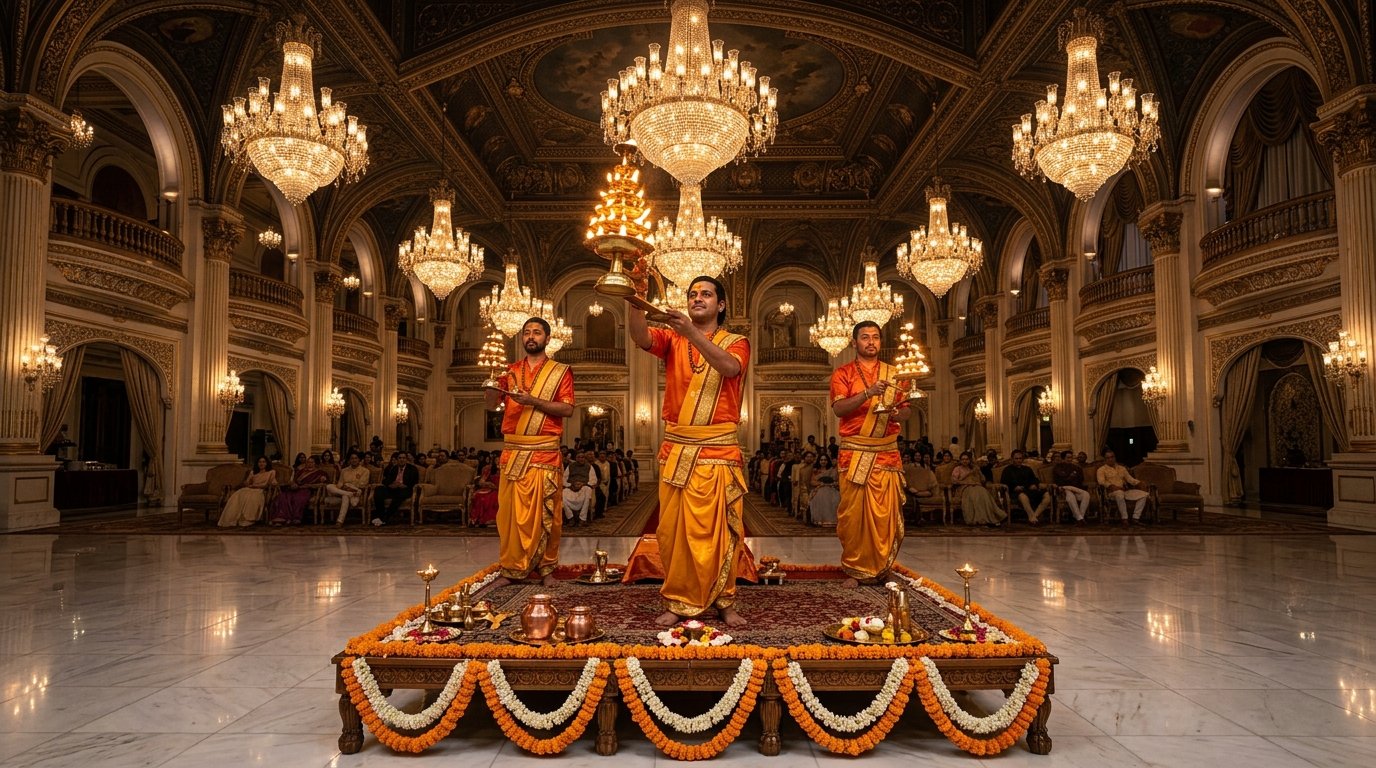
Few sensory spectacles in the world rival the timeless grandeur of the Varanasi Ganga Aarti. The primordial vibration of consecrated conch shells, the synchronized rhythmic rotation of multi-tiered blazing brass deepams, the heady aroma of wild camphor and natural frankincense, and the baritone chant of Vedic hymns create a transcendent aura that commands absolute silence. For high-net-worth couples, prominent business families, and luxury event directors, integrating an authentic Ganga Aarti into a destination wedding, milestone celebration, or high-profile gala has become the ultimate signature of cultural prestige.
Yet, when presenting this sacred vision to the General Manager, Director of Banquets, or Chief Safety Engineer of a five-star luxury hotel—be it The Leela Palace Chanakyapuri, Taj Palace New Delhi, JW Marriott Sahar Mumbai, or ITC Maurya—the immediate operational question is almost always identical:
"How can we permit live, multi-tiered Vedic fire inside a carpeted ballroom hung with imported Austrian crystal chandeliers, equipped with sensitive optical smoke detectors and 68°C thermal water sprinklers?"
Conversely, when couples elect to move the ceremony outdoors to a sprawling palace lawn or waterfront terrace, a completely different set of logistical and atmospheric variables emerges: crosswinds that buffet open flames, acoustic dissipation, and unpredictable outdoor humidity. Here is an insider, technical, and logistical deep dive comparing Indoor Banquet Ballrooms versus Open Luxury Lawns, detailing the exact thermodynamic chemistry, hotel engineering SOPs, and safety protocols that allow Varanasi Ganga Aarti for Weddings to execute flawless, fire-safe ceremonies in India’s finest five-star properties.
The Indoor Dilemma: Understanding 5-Star Hotel Fire Codes
Luxury hotel banquets are governed by rigorous life-safety standards, including the National Building Code (NBC) of India, NFPA (National Fire Protection Association) standards, and municipal fire licenses. The reluctance of banquet managers to approve open-flame rituals does not stem from cultural aversion; it stems from the physics of modern building automation systems:
- Optical (Photoelectric) Smoke Detectors: Unlike older heat-only sensors, modern five-star ballrooms employ laser or infrared obscuration detectors that trigger automatic evacuation alarms if suspended particulate matter (soot, carbon ash, or dense smoke) exceeds micro-thresholds (typically 1.5% to 3.0% obscuration per foot).
- Bulb-Type Water Sprinkler Heads: Ceiling-mounted sprinkler heads are triggered by heat, utilizing heat-sensitive quartz glass bulbs containing liquid that expands and shatters at predetermined temperatures—most commonly 68°C (155°F). A localized column of superheated air rising toward a low ceiling can easily rupture these bulbs, causing catastrophic water discharge of up to 100 liters per minute per head.
- Acoustic & Fire-Retardant Wall Fabrics: Ballrooms are lined with acoustic fabric panels, heavy silk draperies, and plush woven wool or nylon carpeting. If ignited by stray sparks or tipped oil, fire spreads rapidly across non-treated surfaces.
To overcome these legitimate engineering concerns, our turnkey setup deployed through Varanasi Ganga Aarti for Wedding Planners relies on two non-negotiable pillars: Sacred Fuel Chemistry and Pre-Calibrated Safety Engineering.
Minimum Vertical Clearance
14 to 16 Feet minimum ceiling height directly above the priest stage. Ensures the thermal plume dissipates to ambient room temperature before contacting chandeliers or sprinkler heads.
Zero-Soot Fuel Chemistry
100% Pure Desi Cow Ghee + Organic Bhimseni Camphor. Complete hydrocarbon combustion produces zero suspended carbon soot, eliminating optical sensor triggers.
HVAC Zoning & Isolation
Chief engineering liaison initiates a 40-minute localized loop bypass on ballroom ceiling optical zones while maintaining active thermal detectors and 100% fresh air AHU purge.
Sub-Floor Thermal Shield
Heavy-duty flame-retardant silicone/fiberglass underlay concealed beneath ritual carpets ensures zero thermal conduction to hotel wooden parquet or high-pile carpeting.
The Chemistry of Fire Safety: Why Pure Vedic Fuels Don't Smoke
Many amateur event planners mistakenly assume that fire is fire. However, from a chemical and environmental perspective, the difference between cheap commercial puja supplies and authentic Vedic fuels is the difference between an emergency building evacuation and a heavenly, soot-free aromatic experience.
1. Pure Desi Cow Ghee vs. Commercial Adulterated Oils
Commercial vegetable oils, mustard oil, or adulterated ghee blends contain high levels of unsaturated fatty acids, water moisture, and synthetic chemical binders. When ignited, these impurities undergo incomplete combustion, generating thick black smoke rich in unburned carbon particulate matter (PM2.5 and PM10). When these micro-particulates rise into the beam of a ballroom's photoelectric smoke detector, the light is scattered, instantly tripping the fire alarm.
In contrast, our priests burn exclusively single-source A2 Desi Cow Ghee with moisture content below 0.3%. Pure clarified butter consists almost entirely of short- and medium-chain saturated triglycerides that vaporize and burn cleanly at high temperatures (over 250°C). The combustion products are almost exclusively carbon dioxide and water vapor, producing a brilliant golden luminescence with virtually zero suspended carbon soot.
2. Organic Bhimseni (Pacha) Camphor vs. Synthetic Paraffin Tablets
Standard retail camphor tablets sold in local markets are commonly synthesized from turpentine or petroleum byproducts (paraffin wax). When set alight, they emit an aggressive, sooty orange flame accompanied by acrid black smoke that stains ceilings, clings to evening gowns, and triggers sensitive HVAC smoke sensors within seconds.
The Varanasi tradition strictly mandates Grade-A Edible Bhimseni Camphor (Cinnamomum camphora). Bhimseni camphor has a crystalline, flake-like structure that undergoes pure direct sublimation (transitioning directly from solid to gas). When burned, it releases a pristine, luminous white-gold flame and a refreshing, therapeutic herbal aroma with zero acrid smoke and zero soot residue. It is so chemically clean that it leaves no ash behind in the brass Aarti ladle.
"When the hotel’s Chief Fire Officer conducted our pre-event burn test in the engineering workshop of The Taj Mahal Hotel New Delhi, the air quality sensor reading directly above our multi-tiered brass lamp registered particulate levels well below the hotel's safety threshold. Understanding fuel science transforms fire safety from a gamble into an exact engineering protocol."
Comprehensive Head-to-Head: Indoor Banquet vs. Open Lawn
Choosing between an indoor ballroom and an outdoor open lawn impacts everything from visual intimacy to ritual choreography. Below is a detailed technical comparison designed to guide couples, wedding planners, and hotel event managers:
| Technical Dimension | Indoor 5-Star Banquet Hall | Outdoor Palace / Hotel Lawn |
|---|---|---|
| Ceiling & Overhead Clearance | Requires minimum 14-16 ft clear vertical height. Chandelier lines of sight and sprinkler positions must be audited during stage placement. | Infinite clearance. Dramatic open skies allow flames to burn high without vertical containment constraints. |
| Smoke Alarms & Fire Systems | Requires planned sensor bypass with hotel engineering for the ceremony duration (30-45 mins). Thermal sensors remain active. | Zero alarm interference. Smoke dissipates naturally into the atmosphere; no alarm isolation required. |
| Flame Stability & Wind Dynamics | Perfect flame symmetry. Climate-controlled indoor air prevents erratic flickering, ensuring pristine photography and steady deepam rotation. | Subject to crosswinds and evening gusts. Requires heavy-base brass reservoirs and high-wicking dense cotton cores to prevent blowouts. |
| Acoustics & Mantra Resonance | Enclosed cathedral resonance. Shankhnaad and Vedic baritone chants resonate with spine-tingling acoustic depth with minimal amplification. | Acoustic dispersion. Requires dedicated line-array PA speakers, directional wireless lapels, and subwoofers for full emotional impact. |
| Thermal Impact & HVAC | Ballroom AC adjusted 2°C lower 30 minutes prior to ceremony. Air Handling Units (AHU) switched to 100% fresh air intake mode. | Governed entirely by ambient weather. In winter (Nov-Feb), the warmth of the Aarti fires creates a deeply comforting cocoon for seated guests. |
| Floor & Carpet Protection | Mandatory triple-layer barrier: non-slip rubber base, fire-retardant fiberglass matting, and decorative ceremonial runner on stage chauki. | Plywood substructure placed directly over grass or stone terrace, leveled with adjustable screw-jacks. Flower petal borders protect turf. |
| Lighting & Visual Atmosphere | Total lighting controllability. House lights dimmed to 10% golden backlight; Aarti flames create dramatic high-contrast cinematics. | Magical during civil twilight ('Godhuli Bela') as the sky deepens from indigo to starry night, reflecting off water bodies or palace stone. |
| Weather Vulnerability | 100% weatherproof. Completely immune to sudden monsoonal squalls, extreme summer heatwaves, or winter dew/fog. | Requires a wet-weather contingency plan. Heavy rain or wind speeds above 25 km/h requires marquee canopies or relocation indoors. |
The 5-Star Hotel Fire Safety Protocol: Step-by-Step SOP
When wedding planners book a ceremony with Varanasi Ganga Aarti, they do not just receive authentic priests—they receive a complete operational framework that bridges Vedic ritualism with modern hospitality management. Here is the exact SOP executed for indoor five-star banquets across properties in Delhi NCR, Mumbai, Udaipur, and Jaipur:
- Joint Engineering Walkthrough (T-4 Hours): Our Lead Priest and Operations Supervisor walk the ballroom alongside the hotel’s Chief Engineer and Banquet Manager. Stage coordinates are locked directly beneath areas with maximal clearance between decorative chandeliers and sprinkler clusters.
- Localized Smoke Zone Isolation (T-15 Minutes): The hotel’s Building Management System (BMS) operator temporarily isolates the specific optical sensor loop for the banquet hall zone for exactly 40 minutes. Crucially, the thermal heat detection loop and wet-pipe sprinkler grid remain 100% active and primed at all times.
- Pre-Cooling the Banquet Space: The ballroom HVAC thermostats are dropped to 20°C (68°F) to offset the minor thermal output of the Aarti deepams and ensure that rising warm air does not create localized ceiling hot spots.
- Sub-Floor Protection & Safety Perimeter: The wooden priest chauki (platforms) are set atop fire-rated silicone shielding. A designated 3-foot buffer zone between the priests and the guest seating is maintained, framed with fresh marigold and tuberose garlands to prevent guest intrusion.
- Dedicated Discrete Safety Watchers: Two trained logistics assistants dressed in formal hotel attire are stationed at stage wings with Class B/C clean-agent CO2 fire extinguishers, fire blankets, and brass extinguishing snuffer caps, kept entirely out of guest sightlines and wedding photography frames.
- Post-Ceremony Camphor Extinguishment & Air Purge: The moment the Maha Aarti concludes, the flames are naturally allowed to extinguish via pure sublimation or sealed with consecrated brass snuffer lids. The ballroom AHU units engage full air change extraction, and the BMS operator restores the optical smoke loop to normal monitoring.
Planning an Event in a Luxury 5-Star Hotel?
Our team coordinates directly with your venue’s banquet directors and chief engineers, submitting detailed technical spec sheets, fuel safety certificates, and priest credentials to ensure 100% compliance and zero stress for your family.
Minute-by-Minute Ceremony Choreography: The 30-Minute Arc
Whether held in an opulent ballroom or on an expansive lakeside lawn, an authentic Ganga Aarti follows a sacred chronological progression. Every phase is timed to create a gradual crescendo of spiritual intensity, leading seamlessly into the couple’s Varmala or family blessing:
The Consecration & Shankhnaad (Conch Shell Symphony)
The ceremony opens with a collective, resounding blast of the sacred conch shells (Shankhnaad) accompanied by brass gongs and resonant Tibetan-style bells. This primordial sound wave purifies the venue’s acoustic envelope, commanding absolute silence and goosebumps across the hall.
Dhoop Aarti & Agarbatti Sthapana
Priests light ceremonial brass incense burners infused with Guggal, Loban, and natural sandalwood powder. In indoor venues, smoke volume is kept strictly measured, infusing the room with a divine temple fragrance without obstructing air clarity.
The Climax: 108-Wick Multi-Tiered Brass Deepam Aarti
The iconic moment: the priests lift the colossal, 15-kilogram 7-tiered brass lamps fueled with pure cow ghee. In flawless mathematical synchronization, the lamps are rotated in eight cardinal directions to the chant of Har Har Gange. If integrated with a Varmala, the couple exchanges garlands at the apex of this ritual under a shower of golden sparks and rose petals.
Kapur (Camphor) Aarti & Chamara Seva
Single-handled peacock-tail brass deepams filled with organic Bhimseni camphor are ignited, creating intense golden flames that sublime cleanly. Simultaneously, the priests wave royal white yak-hair whisks (Chamara) and ornate peacock feather fans in ancient royal homage.
Pushpa Varsha & Vedic Ashirwad
Thousands of fresh marigold and rose petals are showered upon the couple, family elders, and guests as the Acharyas chant the peace benediction (Shanti Path). Consecrated prasad and Gangajal from Varanasi are presented to the family.
Transparent Investment & Scalable Packages
Whether you are hosting an intimate 100-guest gathering in a boutique luxury ballroom or an opulent 1,500-guest gala on an expansive palace lawn, we offer transparent, all-inclusive tiered packages. Each tier includes verified Sanskrit-educated Vedic Acharyas from Varanasi, all handcrafted brass deepams, pure ritual fuels, and full logistics coordination:
Varanasi Ganga Aarti Packages
Basic Ganga Aarti setup with standard ritual offerings, decoration, and spiritual chanting.
Expanded setup with enhanced sound/chanting presence, elaborate decorations, and extra offering items.
Grand Ganga Aarti experience, double the typical count, significant spiritual resonance, special items & decorations.
Royal Scale Aarti, beautiful formations, massive public/private gathering setup, complete VIP coordination and grand visuals.
For custom multi-city destination requirements, royal palace ceremonies, or high-security corporate conventions, explore our tailored offerings across major hubs including Delhi NCR, Mumbai, and Rajasthan.
Frequently Asked Questions: Fire Safety & Hotel Banquets
1. Can 5-star hotel banquets trigger fire alarms or overhead water sprinklers during Ganga Aarti?
No, when executed according to our standard operating protocol. We burn exclusively pure A2 Desi Cow Ghee and organic Bhimseni camphor, which burn with complete combustion and zero suspended carbon soot. Additionally, we coordinate with the hotel chief engineer to execute a 40-minute localized optical sensor bypass, while thermal heat sensors and sprinkler heads (rated at 68°C) remain active without any risk of tripping at standard 14+ ft ceiling heights.
2. What fuel is burned in the brass deepams to ensure zero smoke indoors?
We strictly prohibit commercial puja oils, kerosene, or synthetic wax tablets. Our team uses only single-source pure desi cow ghee for the multi-tiered brass lamps and pure Grade-A Bhimseni camphor for the final Kapur Aarti. Bhimseni camphor sublimes directly from solid to gas, producing a brilliant golden flame and pleasant fragrance without any oily smoke or residue.
3. Do 5-star hotels require special fire NOC or banquet engineering permissions?
Yes, five-star properties require an internal engineering approval. Our logistics team assists your wedding planner by submitting our standard Technical Safety Dossier—including fuel chemical datasheets, stage dimension plans, electrical clearance schematics, and priest credentials. This turnkey documentation gives hotel management complete assurance and has secured approvals at top hotel chains across India.
4. How do open lawn setups compare with indoor banquets in terms of wind, acoustics, and guest comfort?
Open lawns offer dramatic open-sky vistas and infinite vertical clearance, but require wind-stabilized brass reservoirs and specialized sound amplification (PA line arrays) to combat sound dissipation. Indoor banquets provide superior acoustic immersion, complete climate control, and cinematic lighting control, but require minimum 14-foot ceiling clearances and sensor coordination.
5. What physical safety measures and emergency backups are kept on-site by your team?
Our on-site crew deploys a triple-layer thermal underlay below the wooden chauki to protect the floor from heat and wax spills. Two trained safety assistants are stationed discreetly in the wings with Class B/C clean-agent CO2 extinguishers, fire blankets, and brass snuffer caps. A 3-foot floral buffer zone separates guests from the active flame perimeter.
Final Verdict: Banquet Ballroom or Open Lawn?
If your wedding or event prioritizes thunderous acoustic resonance, controlled cinematic lighting, and total immunity from unpredictable weather, the five-star banquet hall provides an intimate, cathedral-like cocoon where every guest is held in rapt contemplation.
If your event embraces limitless visual scale, twilight sky vistas, water reflection, and grand fireworks or drone displays, the open lawn or palace waterfront offers an unmatched canvas of royal magnificence.
Whichever venue you select, the sacred presence of authentic Vedic priests from Kashi transforms your event from an ordinary celebration into an immortal spiritual memory. To consult on venue feasibility, obtain technical hotel dossiers, or check date availability for your dates, connect with our senior logistics team today.
Planning a Corporate Gala, Wedding, or Festival?
Reserve authentic Varanasi Vedic priests with complete traditional brass paraphernalia. Packages starting from ₹35,000+.

Varanasi Ganga Aarti Trust
Dedicated custodians of eternal Vedic rituals, bringing the sacred grandeur, authentic chantings, and divine blessings of Kashi's holy Ganga Aarti to venues across India and worldwide.